
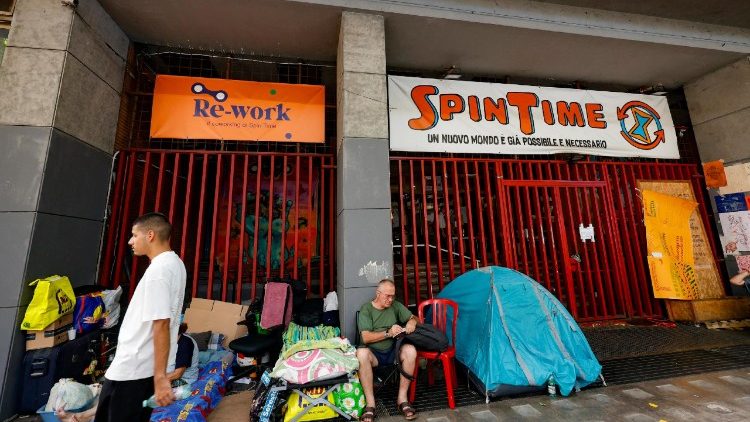
Spin Time: Defending the hope of the most vulnerable
Last October, I had the opportunity to participate in the 5th World Meeting of Popular Movements at the Spin Time center in Rome. Cardinal Michael Czerny accompanied us; we celebrated the first Jubilee Pilgrimage of Popular Movements by crossing the Holy Door of St. Peter’s Basilica, and we met Pope Leo XIV in an audience, where we heard his heartfelt “I am with you!”
Spin Time was born in Rome in October 2013, when the movement for the right to housing occupied an abandoned public building that had been the headquarters of the former INPDAP, the public body responsible for managing social security, pensions, and assistance for workers and public-sector officials in Italy.
Over time, the space became much more than an occupation aimed at addressing a housing emergency: it became a social and cultural laboratory for coexistence and an effective, nonviolent response for many families facing the violence of a system that left them excluded and on the streets.
Since its beginnings in 2013, the Church has provided pastoral support to Spin Time thanks to Sister Adriana Domenici and the auxiliary bishops. The priest Mattia Ferrari, with whom some members of Spin Time had shared experiences of working with marginalized communities, has also been a key figure in this process.
In May 2019, Cardinal Konrad Krajewski, then the papal almoner of Pope Francis, personally went to Spin Time after the building’s electricity was cut off and helped restore the supply. The gesture had an enormous public impact and became a symbol of an embodied Church that stands alongside vulnerable and excluded people.
From then on, collaboration between Spin Time and different sectors of the Church expanded: parish and pastoral activities were developed inside the building, and Spin Time became a meeting place for social movements, religious communities, associations, and people from different traditions.
In 2024, L’Osservatore Romano presented the experience as the “Spin Time model”, highlighting the collaboration among residents, volunteers, associations, the Church, and institutions to defend the rights of its inhabitants.
The 5th World Meeting of Popular Movements was an opportunity to learn about this model firsthand, a living testimony to an organization of hope that refuses to resign itself.
As director of the Catholic Nonviolence Initiative of Pax Christi International, I found that the meeting experience confirmed for me that this is an authentic house of peace and Gospel nonviolence in the heart of Rome and at the service of the most vulnerable people, families, and groups.
Its creative, constructive resistance, and in dialogue with the whole city and with the world, is an example of nonviolent response.
There have been many attempts to end this experience since its inception, but many creative forms of resistance persist there and bear witness at Spin Time.
