
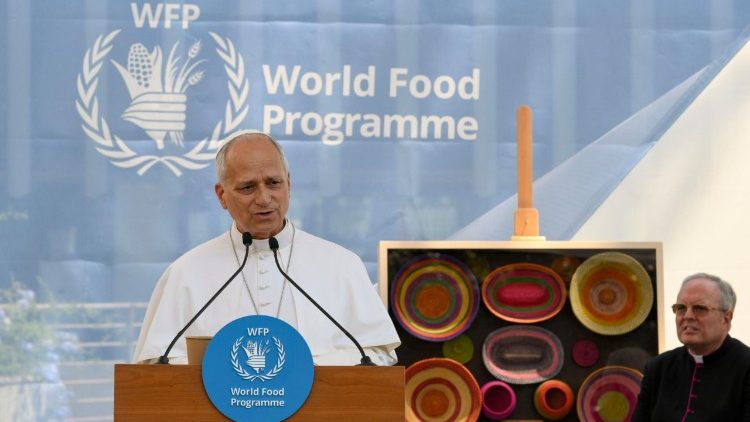
Pope to WFP: Conflicts are 'fed' more readily than people are nourished
"Together, we share the urgent task of confronting hunger and malnutrition, while also tackling the underlying structural causes that sustain them. To meet this task effectively, we must examine the challenges before us, their underlying causes, and the paths toward lasting solutions."
Pope Leo XIV expressed this during his address to the Executive Board of the United Nation's World Food Programme at its Rome headquarters on Monday.
In his remarks, he stressed that multilateralism is essential and that basic needs like water, food, and healthcare cannot be subordinated to geopolitical interests.
The Pope thanked the intergovernmental institution for its dedication to saving lives in emergency situations and providing food assistance amid conflicts and natural disasters, noting their institution’s commitment resonates profoundly with the Catholic Church’s mission to uphold human dignity and to foster fraternity, rooted in the Gospel’s call to love our neighbor.
Today, he observed, crises have evolved from isolated events into persistent realities, marked by prolonged conflicts, chronic food insecurity, economic volatility, and growing climate vulnerabilities.
This reality, he noted, raises a fundamental question of "what configuration of the global order is capable of producing, reproducing, and, at times, normalizing such conditions?"
He said the issue is no longer limited to how to intervene, but rather "extends to understanding why the system constantly produces the very problems it is then forced to correct."
He lamented that the international order has become increasingly fragmented, arising in part from the crisis of the multilateral system, observing that states have increasingly allocated their resources towards national security, economic growth, and domestic stability, disregarding the close link between these issues and multilateral cooperation.
This trend, the Holy Father noted, reveals a striking paradox, where "unprecedented global productive capacity exists alongside expanding zones of extreme vulnerability."
"It is precisely within the gap between acknowledgement in principle and prioritization in practice," he continued, "that we witness the progressive bureaucratization of solidarity alongside the quiet commodification of human life."
On the one hand, he said, humanitarian action is increasingly burdened by bureaucratic procedures that can delay assistance to those in need, but on the other, access to essential goods, including food, is too often influenced by economic or strategic considerations.
